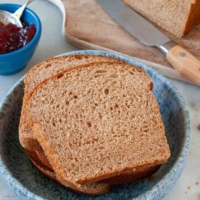
100% Whole Wheat Sandwich Bread (Bread Machine Dough, Oven-Baked)
This whole-grain loaf is mixed and kneaded in a bread machine, then shaped and baked in a conventional oven for better texture and sliceability. Optional ingredients include peanut butter or sunflower butter and vital wheat gluten.
12
slices
Ingredients
- 1¼ cups (284 g) water
- 1¼ teaspoon salt
- 2 tablespoons (23 g) avocado, canola, or coconut oil - (add one more tablespoon if not using peanut butter)
- 1 tablespoon creamy peanut butter or sunflower seed butter - (optional)
- 3 tablespoons (63 g) honey
- 3 tablespoons (22 g) nonfat dry milk
- 2 tablespoons vital wheat gluten (optional)
- 2⅞ cups (345 g) whole wheat flour - (if not using vital wheat gluten, add two additional tablespoons of whole wheat flour for 360 gr total)
- 2 teaspoons instant yeast
Instructions
- Make Dough: Add 1¼ cups water, 1¼ teaspoon salt, 2 tablespoons avocado, canola, or coconut oil, 1 tablespoon creamy peanut butter or sunflower seed butter, (optional--if not using, add another tablespoon of oil), 3 tablespoons honey , 3 tablespoons nonfat dry milk , 2 tablespoons vital wheat gluten (optional), 2⅞ cups whole wheat flour, (if not using vital wheat gluten, add two additional tablespoons of whole wheat flour for 360 gr total), and 2 teaspoons instant yeast to the bread machine pan in the order listed. Select the DOUGH Cycle and press START. Let the machine run for 1 minute then STOP it.
- Rest Period: Let the dough rest for 30 minutes to hydrate the flour and kickstart gluten development. (Zojirushi users: Set the timer for 2:00. Press START, and the DOUGH cycle will begin after 30 minutes.)
- Restart DOUGH Cycle: After the rest, restart the DOUGH cycle. Open the lid and check that the paddles are engage and dough is forming a ball.
- Check Consistency (15–17 Minutes In):Too Wet? Add flour 1 tbsp at a time until it sticks to the sides and pulls away cleanly.Too Dry? Add water 1 tbsp at a time until the dough is tacky but not sticky. Find out more about this surprising secret to success with a bread machine here.
- Dough Rising: Let the dough rise during the DOUGH cycle until doubled in size. At the end of the DOUGH cycle, I like to restart the DOUGH cycle and run it for 5 seconds to compress the dough before shaping
- Shape the Dough: Pull the dough out of the machine onto a lightly floured or damp surface. Press into a rectangle. Use a rolling pin to make it evenly thick and remove rogue bubbles.Roll into a cylinder, avoiding air pockets, and pinch the seams closed.
- Place in Pan: Transfer the dough, seam-side down, into a greased or parchment-lined loaf pan (4½ x 8½-inch or a Pullman pan 9x4x4-inch).
- Final Rise: Cover with a damp tea towel or shower cap. Let rise in a warm spot until even with the pan edge for the 9x4 Pullman pan (or 9x5 pan if you end up using that one). Allow the dough to rise about 1 inch above the top for an 8½ x 4½ pan.
- Preheat oven to 350˚F (180˚C).
- Bake: Place the loaf onto the center rack of your hot oven for 35 minutes or until the internal temperature reads 195˚ to 200˚F. (90-92˚C).
- Cool: Let sit in the pan for 5 minutes, then transfer to a cooling rack for at least 30 minutes. If desired, brush with softened butter after cooling. Brushing it on while hot can cause wrinkling.
Notes
Machine Capacity: Avoid doubling this recipe. Most bread machines cannot adequately knead more than 4½–5 cups of flour and may overheat.
Make Ahead: Dough can be refrigerated after the DOUGH cycle or shaped first and chilled overnight. Let rise until soft and puffy before baking.
Freezing Options:
Active dry yeast may be substituted. Use about ¼ teaspoon more than instant yeast. Dissolving first is optional.
- Unbaked dough: Freeze after the DOUGH cycle or after shaping (before final rise). Defrost in the fridge overnight.
- Baked rolls: Double-wrap and freeze up to one month. Reheat gently. Frost after thawing.
- Stand Mixer: Mix until moistened, then knead with a dough hook (speed 2–3) until smooth and elastic (5–10 minutes). Let rise, deflate, and shape as directed.
- By Hand: Mix to a shaggy dough, knead on a floured surface until smooth and elastic (10–20 minutes). Let rise, deflate, and shape as directed.
Active dry yeast may be substituted. Use about ¼ teaspoon more than instant yeast. Dissolving first is optional.
Nutritional Information
Serving: 1slice | Calories: 151kcal | Carbohydrates: 28g | Protein: 5g | Fat: 3g | Saturated Fat: 1g | Polyunsaturated Fat: 2g | Monounsaturated Fat: 1g | Trans Fat: 1g | Cholesterol: 1mg | Sodium: 255mg | Potassium: 164mg | Fiber: 4g | Sugar: 5g | Vitamin A: 44IU | Vitamin C: 1mg | Calcium: 36mg | Iron: 1mg