Rustic Ciabatta with Biga (Bread Machine Dough)
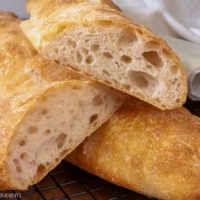
This rustic ciabatta starts with an overnight biga for flavor and chew. After mixing the dough in your bread machine, let it rise in a container, shape it gently into two flour-dusted logs, and bake on a lined baking sheet to create the classic airy texture and crisp crust.
16
slices
Ingredients
Biga-make the night before
- ⅛ teaspoon (⅛ teaspoon) instant or bread machine yeast
- ½ cup (114 g) water, cool
- 1 cup (120 g) unbleached all-purpose flour
Ciabatta Dough
- ½ cup (114 g) water, cool
- ¼ cup (57 g) milk, cool
- 1½ teaspoon table or sea salt
- 2 cups (240 g) unbleached all-purpose flour - (See notes about using bread flour.)
- ½ teaspoon (½ teaspoon) instant or bread machine yeast
- flour, semolina, or cornmeal for flouring the board and your hands
Instructions
- Prepare the biga: Combine ⅛ teaspoon instant or bread machine yeast, ½ cup water, cool, and 1 cup unbleached all-purpose flour in the bread machine pan or another container. Mix briefly using the DOUGH cycle or by hand. Scrape down the sides, cover, and let rest at room temperature for 12–24 hours. Refrigerate if holding longer; bring to room temp before continuing.
- Mix the dough: Add ½ cup water, cool, ¼ cup milk, cool, 1½ teaspoon table or sea salt, 2 cups unbleached all-purpose flour and ½ teaspoon instant or bread machine yeast to the pan with the biga.Start the DOUGH cycle.
- Check dough consistency: At 15–18 minutes, open the lid and check the dough. It should be shiny, sticky, and wrapping around the paddle. Adjust with water or flour, 1 tablespoon at a time, if needed.
- First rise in a container: When kneading stops, interrupt the DOUGH cycle and transfer the dough to a well-oiled rectangular container (Mine holds 3 quarts). Use a spatula to flip the dough and coat it with oil. Cover and let rise until doubled or tripled.
- Stretch and fold: Using a greased spatula, lift each corner of the dough inside the container toward the center. Cover and rest for 30 minutes. Repeat the folds once more, then rest another 30 minutes.
- Shape the loaves: Gently tip the dough onto a clean, flat surface like a large cutting board or a silicone baking mat. Use flour, semolina, or cornmeal for flouring the board and your hands. Stretch into a rectangle approximately 12 x 8 inches. Divide in half lengthwise with an oiled bench scraper or knife. Use floured or oiled hands and a bench scraper to fold the long inside edges of each half over the top toward the outside edge, then fold the outer edges back toward the center. Dimple the surface with your fingertips. This takes practice. Don't expect perfection the first time.
- Final rise: Place loaves on a prepared baking sheet or leave them on the silicone mat you used for shaping and shift to the baking sheet. Cover and let rise until puffy, about 30–45 minutes.
- Bake the ciabatta: Preheat oven to 450˚F (230˚C). Spritz loaves with water and bake for 18–22 minutes, respritzing during the first 5 minutes. Bread is done when golden brown and internal temp reaches 210˚F (98˚C).
- Cool completely: Let loaves rest on a wire rack for at least 1 hour before slicing.
Notes
Note about the flour (9/21/23): I have discovered that I prefer to substitute 1 cup of bread flour for 1 cup of all-purpose flour when mixing the dough. It seems to strengthen the dough as it rises, and I like the chewy texture it lends to the baked ciabatta.
Heads-up: Avoid doubling this recipe. Anything above 4.5-5 cups of flour won’t knead properly in most machines and can cause overheating. More details here.
Stand Mixer Method:
- Add ingredients to the bowl in the listed order.
- Mix on LOW until moistened, then knead on speed 2 or 3 with a dough hook for 5-10 minutes until smooth and elastic.
- Continue with step 4 in the recipe
Nutritional Information
Serving: 1 | Calories: 89kcal | Carbohydrates: 18g | Protein: 3g | Fat: 1g | Saturated Fat: 1g | Polyunsaturated Fat: 1g | Monounsaturated Fat: 1g | Trans Fat: 1g | Cholesterol: 1mg | Sodium: 76mg | Potassium: 35mg | Fiber: 1g | Sugar: 1g | Vitamin A: 4IU | Vitamin C: 1mg | Calcium: 9mg | Iron: 1mg