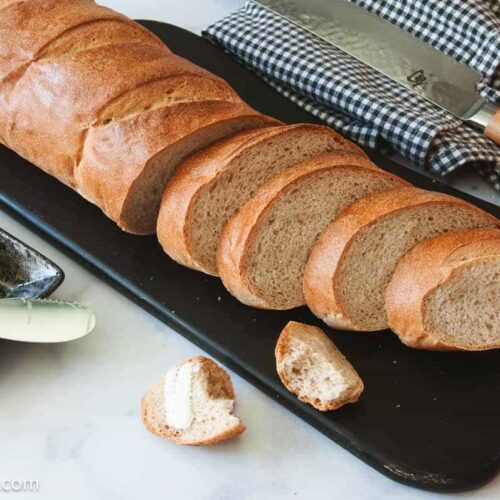
50/50 Whole Wheat French Bread (Bread Machine Dough & Oven Baked)
A half-whole-wheat and half-bread-flour dough is made in the bread machine, shaped by hand, and baked in a conventional oven. The result is a tender crumb with a balanced flavor and a crust that softens as it cools. Don't skip the soaking part in step two, as it will make a big difference in the texture of your bread.
12
slices
Ingredients
DOUGH
- 1 cup + 3 tablespoons (270 g) cool water
- 1½ teaspoons sugar
- 1½ teaspoons butter
- 1½ teaspoons salt
- 1½ cup (168 g) white whole wheat flour
- 1½ cup (180 g) bread flour
- 1 teaspoon instant or bread machine yeast
GLAZE
- 1 egg white + 1 teaspoon water
Instructions
- Make the dough: Place all of the dough ingredients: 1 cup + 3 tablespoons cool water, 1½ teaspoons sugar, 1½ teaspoons butter, 1½ teaspoons salt, 1½ cup white whole wheat flour, 1½ cup bread flour, 1 teaspoon instant or bread machine yeast into a bread machine pan in the order listed.
- Select the DOUGH cycle and press START. Run the machine just long enough to ensure that all ingredients are mixed together. Unplug or shut off the machine and let the dough rest for about 20 minutes, allowing the flour time to absorb moisture. Restart the DOUGH cycle.
- First check: After a minute, check the dough to make sure it is coming together into a raggedy ball. If not, add more water 1 tablespoon at a time. If you see pancake batter instead of dough, you forgot some flour—just add it slowly until everything pulls together.Second check: Check dough again after about 15 minutes. The dough should stick to the sides of the pan, then pull away cleanly. If too wet, add flour 1 tablespoon at a time. If too dry and the dough doesn't stick at all, add more liquid. See more details--Surprising Secret for Making Better Bread with a Bread Machine.NOTE: Bread dough is influenced by flour, humidity, and even your kitchen temperature—so use this step to fine-tune the dough for your environment.
- Restart the machine: With the dough still in the bread machine pan, restart the DOUGH cycle and let it run for about 5 seconds to compress the bubbles before shaping. Stop the machine. (This results in a more even texture without noticeably large holes.)
- Preparing the dough: Remove the dough from the pan onto a lightly floured surface. Shape it into a loose ball. Cover and let it rest for 15 minutes.
- Shaping the dough: Roll the dough into an oval shape slightly longer than you want your final loaf to be (about 9 x 12 inches is what I do.) Starting from a long side, roll the dough tightly into a cylinder. Pinch the seam and ends to seal. (See video.) Place seam-side down on a greased or lined baking sheet.
- Cover and final rise: Cover with a tea towel and allow to rise in a warm place (70–72˚F [21–22˚C] is ideal) until almost doubled in size. Whole wheat tends to rise faster than white flour. Check after 20-30 minutes. Don’t go by the clock, go by the appearance.
- Preheat oven to 425˚F (220˚C).
- Glaze: Whisk 1 egg white + 1 teaspoon water together for the glaze. Brush it over the loaf.
- Slash and Bake: Make diagonal slashes across the top. Bake for 20 minutes, or until golden and bread reaches 200°F (93°C) internally.
- Cool and serve: Remove to a cooling rack or slice and enjoy warm.
Notes
Heads-up: Avoid doubling this recipe. Most bread machines cannot adequately knead more than 4½–5 cups of flour and may overheat. More details here.
Make Ahead: Dough can be refrigerated after the DOUGH cycle or shaped first and chilled overnight. Let rise until soft and puffy before baking.
Freezing Options:
- Unbaked dough: Freeze after the DOUGH cycle or after shaping (before final rise). Defrost in the fridge overnight.
- Baked bread: Double-wrap and freeze up to one month. Reheat gently.
- Stand Mixer: Mix until moistened, then knead with a dough hook (speed 2–3) until smooth and elastic (5–10 minutes). Let rise, deflate, and shape as directed.
- By Hand: Mix to a shaggy dough, knead on a floured surface until smooth and elastic (10–20 minutes). Let rise, deflate, and shape as directed.
Nutritional Information
Serving: 1slice | Calories: 117kcal | Carbohydrates: 23g | Protein: 5g | Fat: 1g | Saturated Fat: 0.4g | Polyunsaturated Fat: 0.1g | Monounsaturated Fat: 0.2g | Trans Fat: 0.02g | Cholesterol: 1mg | Sodium: 301mg | Potassium: 46mg | Fiber: 2g | Sugar: 1g | Vitamin A: 16IU | Vitamin C: 0.003mg | Calcium: 14mg | Iron: 1mg