
How To Tell When Homemade Yogurt Is Done (4 Simple Checks)
Sneak Preview: Not sure if your homemade yogurt is ready? These four quick checks tell you when yogurt has set—without disturbing incubation. Includes typical incubation times (3–10 hours) and troubleshooting tips.
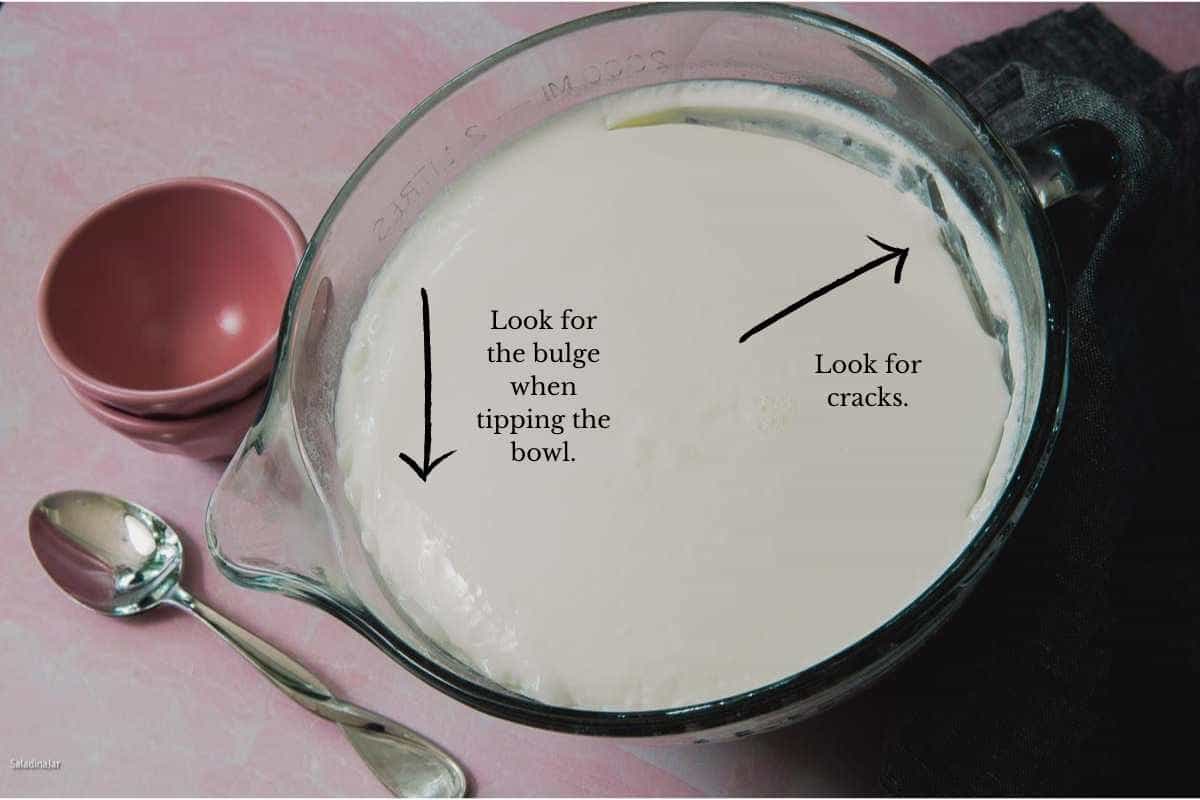
After hundreds of batches in my Texas kitchen, I’ve learned a few simple signs that tell you when yogurt has set—no guessing, no poking, no wasted milk.
If you’re brand-new to yogurt making, begin with my guide to making Greek yogurt at home without special equipment, then come back here to check if your batch is ready.
Typical Yogurt Incubation Time
• Mild yogurt: 3–5 hours
• Tangier yogurt: 6–10 hours
• Cold-start yogurt: often 8–12 hours
Times vary with temperature, starter strength, and how tangy you like your yogurt. I usually incubate at 100–110°F.
4 Ways To Tell When Homemade Yogurt Is Done
1. Shake Test – Yogurt jiggles like soft Jello. If it splashes, it needs more time.
2. Tilt Test – Tip the bowl slightly. Set yogurt bulges but doesn’t run.
3. Side Test – Yogurt clings to the container when set.
4. Knife Test – Knife comes out mostly clean.
What Not To Do When Checking Your Yogurt
Careless handling can lead to a yogurt fail. Avoid these mistakes:
- Don’t check too early. Opening or stirring before the yogurt sets can interrupt fermentation.
- Don’t move the container. Keep yogurt still while it incubates, especially in the first hour.
- Don’t add more starter. If nothing is happening, adding starter won’t help—check your temperature instead.
Note: If yogurt hasn’t set after 10 hours, recheck your temperature (100–110°F is ideal) and starter strength.
Common Questions About Yogurt Setting
Why Is There a Skin on Top of My Yogurt?
A skin forms when yogurt incubates uncovered or at higher temperatures. It’s harmless—just lift it off before stirring.
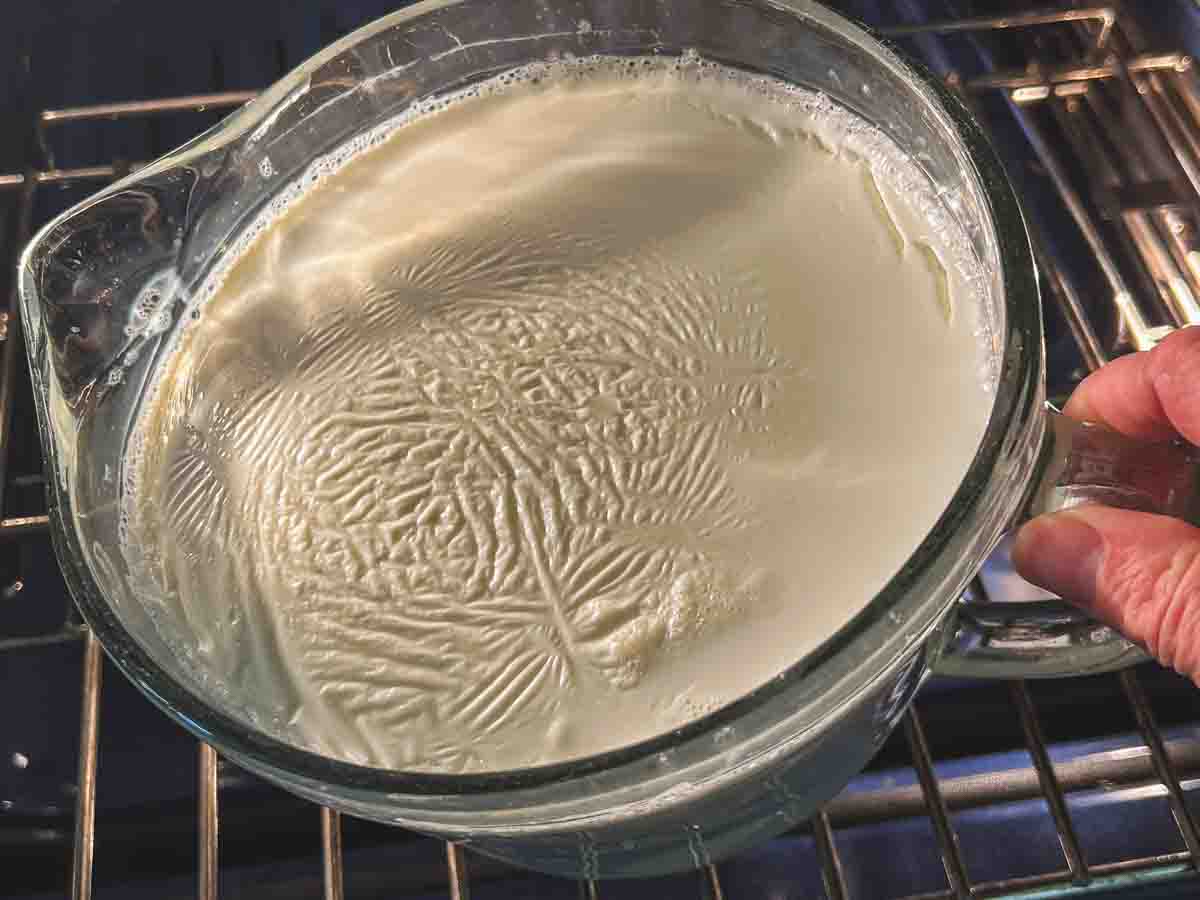

What Is the Clear Liquid on Top?
That’s whey, a by-product of the fermentation process. It’s safe to eat. Stir it back in for thinner yogurt or strain it for Greek yogurt or Skyr.
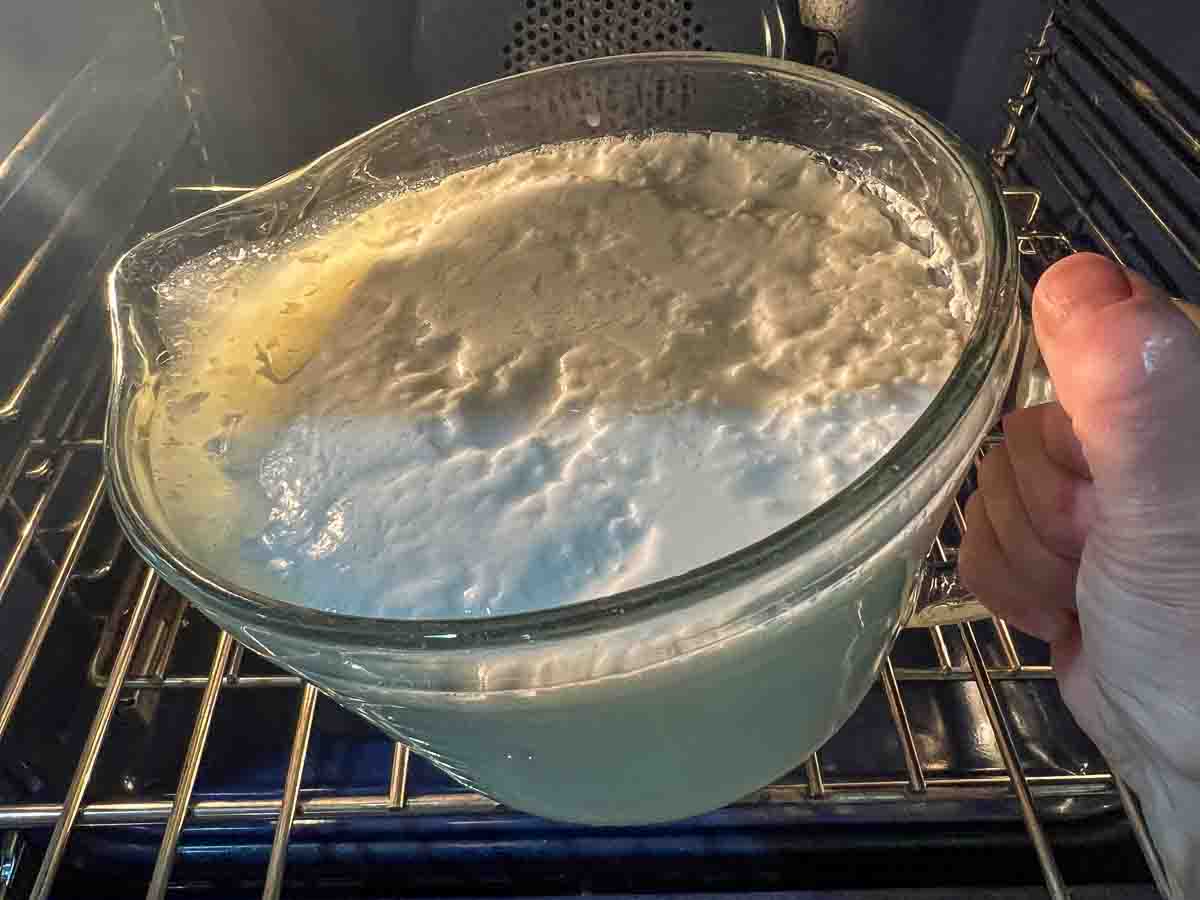
Why Does My Yogurt Look Curdled?
Usually caused by weak starter, old milk, or temperature that’s too high. Straining and whisking often smooths it out.
It’s been 10 hours and my milk hasn’t changed. Now what?
Check your incubation temperature (aim for 100–110°F) and your starter. If it still smells fresh, try again with a new starter.
It has been over ten hours and my milk hasn’t changed. Now what?
Check your incubation temperature (aim for 100–110°F) and your starter. If it still smells fresh, try again with a new starter. Double-check the temperature. If it’s below 100°F, try a different incubation method. If it still smells OK, you can try again–directions here.
How long can yogurt sit out after it’s done?
Refrigerate within about 2 hours. If you plan to strain for Greek yogurt or Skyr, you can strain while it’s still warm–it goes much faster that way.
Final Thoughts
Knowing when your yogurt is set gets easier with practice. Don’t give up! With these tips and a little patience, you’ll be making smooth, creamy yogurt in no time.
— Paula, Home Economist
Homemade Food Worth Sharing
Need help troubleshooting?
Email me: Paula at saladinajar.com — photos help!

Where’s the video? You promised a video at the beginning of the article. I need to see it live action to understand.
Hi C.B.
Do you happen to have an ad-blocker on your search engine? If so, turn it off for a bit and you should be able to see the video. You will find it near the end of the post.
I also want to leave a cautionary tale for making yogurt in the Instant Pot. The very last time I made yogurt, the yogurt had an off taste, that in retrospect, I think was due to using the gasket that is frequently used for savory dishes. I may have learned the hard way to use a different gasket for yogurt and non-savoRy food. The other option is to leave off the gasket for making yogurt. It is not necessary for the yogurt process. I am hoping this will solve this problem.
I haven’t commented in a while, and I would like to make a couple of points that may help other readers. I have now been making yogurt for a long time using my instant pot: My method is using the yogurt setting on the instant pot until the pot shows “boil.” (This takes about 35 minutes for the 2 quarts plus 2 cups of 2% milk that I use). I switch to the low slow cook setting for 25 minutes, then remove the pot and cool it down to about 112° F by putting the pot in a Dutch oven with ice and water at the bottom. Then I mix in 32 grams of Fage yogurt or homemade yogurt and set the final yogurt Instant Pot setting to 13 hours.
Now, I know that it is believed that 13 hours will make the yogurt quite tart, but the result I get is very mild. A while back, I got tart results by re-using the homemade yogurt a number of times. If I stick to using Fage, it is mild every time. I would guess that the yogurt would be set earlier, but I set it for 13 hours out of convenience, allowing me to start making it at 6 PM and have it be be ready by about 8:30 AM.
Hi Caryn,
Thank you for adding to the discussion. I rarely use an Instant Pot these days so it’s good to have your experience in writing.
I strain my yogurt for about an hour to get a thick consistency. On a good day, I get about 500g of Greek yogurt from a 1 litre milk. On a bad day, when the yogurt doesn’t set well ie. it’s watery, I only get 300g. May I know what would be considered a “well set yogurt” in terms of how much thick Greek yogurt you can get yield in terms of weight.
Hi Iris,
I’m so glad you reached out. How much whey you get has much to do with the freshness and quality of your milk and starter. There is no standard for “well set yogurt” that I know of. What kind of starter are you using and how old is it when you use it? It’s best to use starter that’s no more than 7-10 days old. After that, there’s not enough live and healthy bacteria to culture the milk.
When using fresh, high quality milk and starter, and incubating the yogurt at a consistent temperature that’s not too high or too low, how much whey you get usually corresponds with how long you strain it. If you want more Greek yogurt, don’t strain it as long.