
How To Make Ricotta-Style Cheese with Yogurt Whey
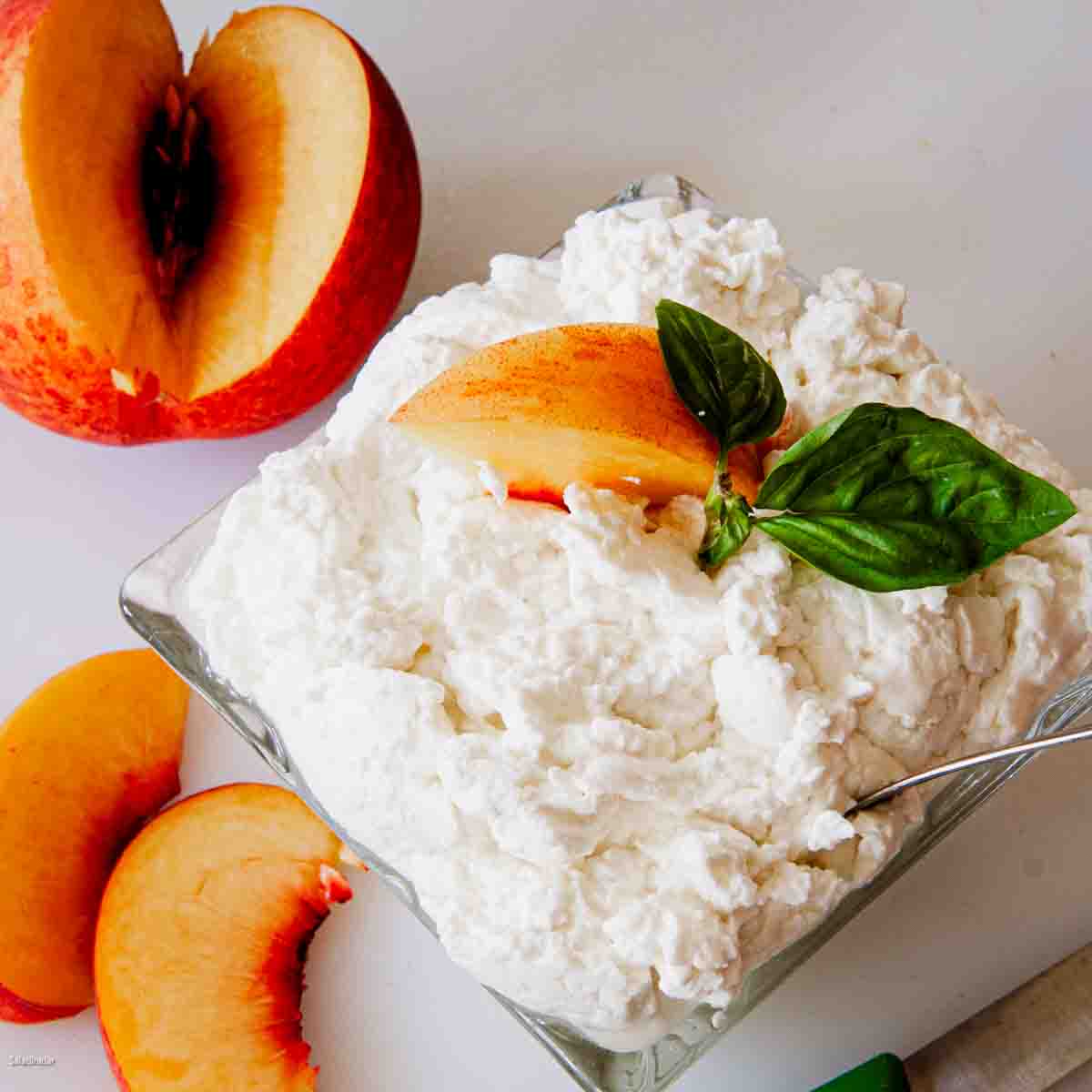
Sneak Preview: Make fresh ricotta-style cheese from the whey left over after straining Greek yogurt. This mild, creamy cheese comes together in about 40 minutes and works in both sweet and savory recipes.
This post contains affiliate links. As an Amazon Associate, I earn from qualifying purchases at no extra cost to you.
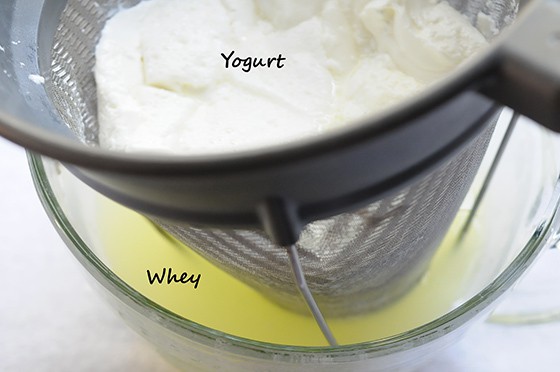
Are you a Greek yogurt maker with lots of whey leftover? Making ricotta cheese is another idea for using the whey resulting from straining regular yogurt. It’s also a great way to repurpose “failed yogurt.”
If you make Greek yogurt regularly, you’ve probably wondered what to do with all that leftover whey. Instead of pouring it down the drain, use it to make a mild ricotta-style cheese that’s delicious in lasagna, stuffed shells, cheesecake, or simply spread on toast.
Making ricotta cheese is another idea for using the whey resulting from straining regular yogurt. It’s also a great way to repurpose “failed yogurt.”
Whey Curious? Here’s What You Should Know
Step-by-Step Instructions for Ricotta-Style Cheese
⬇️ See the recipe card for exact amounts and complete instructions.
How To Make Ricotta-Style Cheese with Yogurt Whey
Video
Ingredients
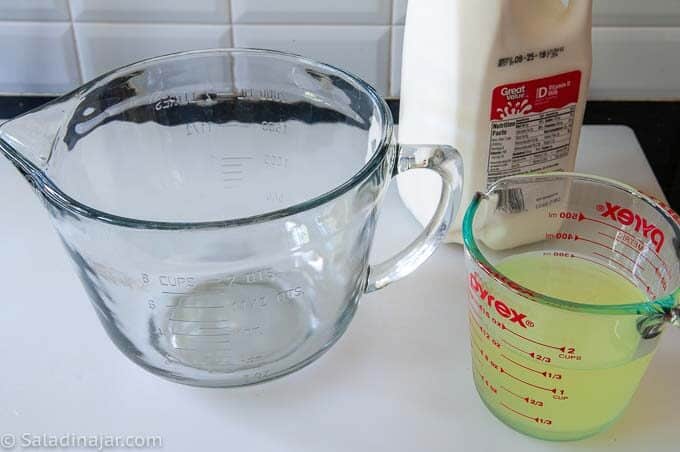
- 2 cups (454 g) whey drained from making Greek yogurt drained from making Greek yogurt
- ½ gallon (1816 g) milk whole or 2%
- ½ teaspoon salt
Instructions
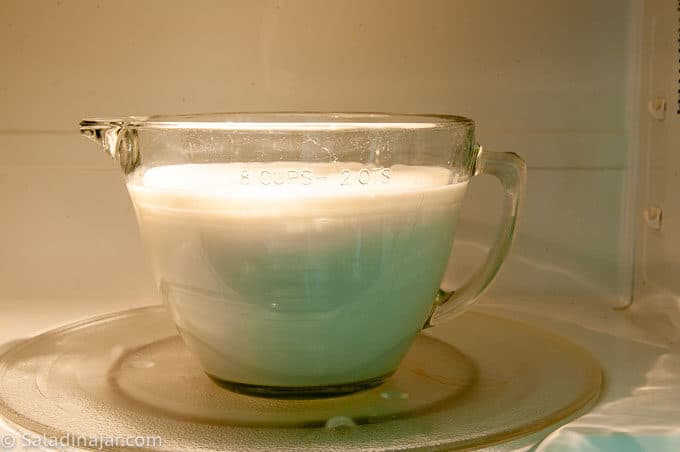
- Combine milk and whey: Stir 1/2 gallon (1816 g) milk and 2 cups (454 g) whey drained from making Greek yogurt together in a large saucepan or microwave-safe bowl. Add 1/2 teaspoon (½ teaspoon) salt if desired.
- Heat gently: On the stove, heat to 180°F (82°C) without stirring. For microwave, heat on HIGH for 18–20 minutes or until the mixture reaches 180–190°F. (Microwave times vary—use a thermometer for accuracy.)
- Let sit: Remove from heat and let the mixture rest undisturbed for 10–15 minutes as curds form.
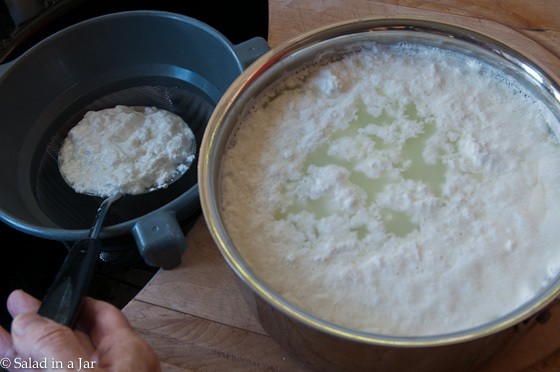
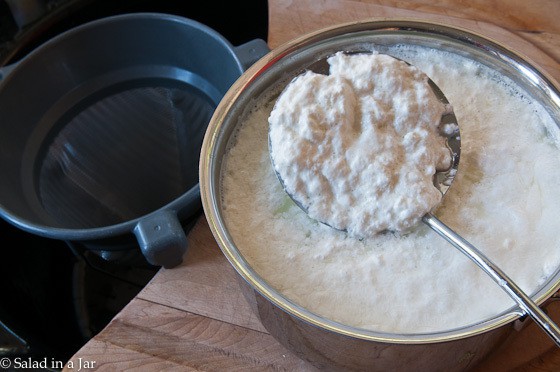
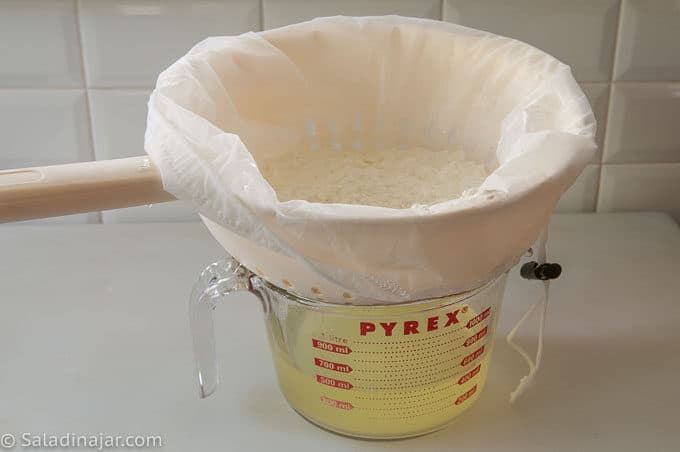
- Scoop curds: Use a slotted spoon to gently lift curds into a fine-mesh strainer or a colander lined with a clean T-shirt, cheesecloth or an industrial-size paper coffee filter. (Do not pour curds into strainer all at once!)
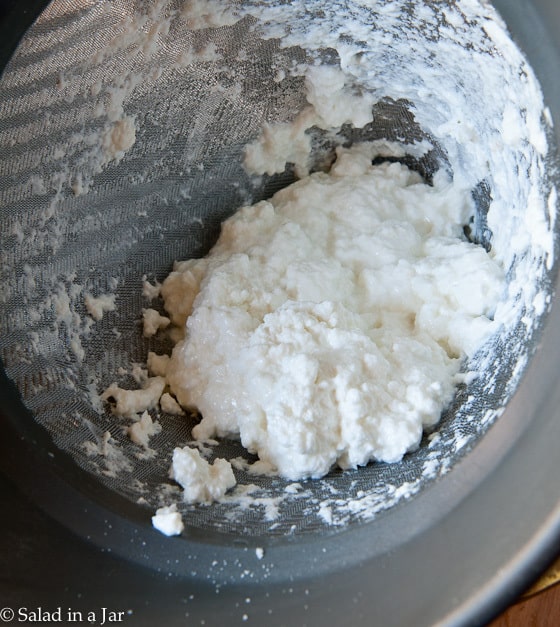
- Drain ricotta: Let drain until it reaches your desired consistency, usually 15–30 minutes.If you feel like your ricotta is too dry, add a little heavy cream.
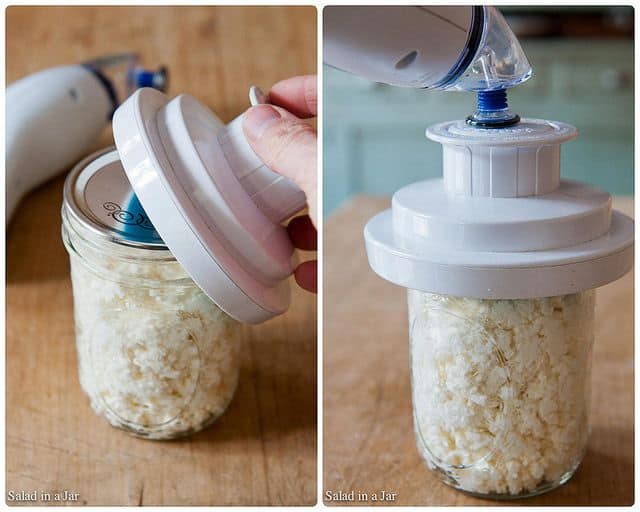
- Store: Transfer to a sealed container and refrigerate for 4–7 days. Vacuum seal for 2 weeks or freeze for longer storage.
Notes
Equipment
Nutrition
All images and text ©️ Paula Rhodes for SaladinaJar.com
Final Thoughts
Try this method and enjoy homemade ricotta tailored to your taste!
Need help troubleshooting? Email me: Paula at saladinajar.com—photos welcome!

When measuring temp, where should the thermometer be in the pot, the sides are a lot cooler than the middle. if I’m not stirring, then it’s gunna reach temp in the middle way before the sides do
Hi Ashlee,
Normally, the milk will be cooler in the middle than on the sides, whether you warm it in a microwave or on the stove. If you are concerned about it, give the milk a quick stir before you measure the temperature. If I didn’t answer your question, please write back to clarify.
This isn’t Ricotta, this is Paneer. You are basically making cheese from the milk, using the acidity of the yogurt whey, but you can also just use lemon juice or vinegar.
If you press the cheese curds into a block, you can get a firm cheese, cut into cubes, fry in butter and then make yourself some lovely palak-paneer. Cheers!
You’re absolutely right—paneer and this ricotta-style cheese start the same way. The difference is in how they’re finished. Paneer gets pressed into a firm block, while this version stays loose and spoonable, more like ricotta in texture and how it’s used. Lemon juice or vinegar would work too, but I like giving leftover whey another job. Palak paneer does sound delicious, though.
It reads as you’ll still have leftover whey. Can you just keep repeating the cycle?
Hi friday,
You can, but as the whey loses its acidity, it may require more whey or a new batch to curdle the milk. Can’t predict at what point that might happen, but when it does, just use fresh whey from a new batch of yogurt.
Hi, in Australia we use the metric system. We round up everything to the nearest litre or gram, so instead of saying 1816 (should be mls not grams), we would use 2 litres of milk and we would also use 450grs of whey. Mls are for liquid, grams for flour etc.
Not sure if this will turn out the same as our recipes are made for this, but just thought I’d let you know, cause it’s just wrong for us to see metric measurements like this.
Saying that, I’m making a batch of yoghurt right now in my yoghurt maker and I’ll try this recipe as I have a lot of whey left over, so ??
Hi Vyonne,
Thanks for your message! I convert all liquid measurements to grams because I don’t have a good way to measure milliliters. It’s just easier for me to weigh everything, and I’ve found it keeps things consistent, especially when baking. Most liquids, like water and milk, weigh close enough gram-for-mL that it works beautifully in home cooking.
Thanks again for reaching out! I hope your ricotta turns out delicious.
I can’t believe I’ve been pouring the whey from my homemade yogurt down the drain! I tried this recipe today and I have to say this is the best ricotta I’ve ever had. Absolutely delicious. I could just eat it with a spoon. and it couldn’t be any easier to make. thank you so much for the recipe and video.
Hi Patricia,
I agree with you. It doesn’t get any fresher than when you make it yourself. Thanks so much for taking the time to write.
I make my yogurt with UHT whole milk. Will the whey still work?
I live on an island and fresh milk is very expensive. Thank you
Hi Judy,
I would think so. UHT milk is hard to find in my part of the woods, so I have little experience with it. However, the whey will still be acidic and that’s what separates the milk into “curds and whey.”
What heat setting should I set my stove to so I don’t scorch the milk? Low? Medium?
Thanks!
Hi Becky,
I would heat on MEDIUM. Stir frequently. (The thickness of your pan and the way your stove works (gas, electric, conduction, etc.) will have a huge effect. Follow your instinct.
Hi Paula,
How long is it reasonable to keep yogurt whey in the freezer? I used to make a lot of Greek yogurt, and froze a lot of whey, but it’s been years. Would it serve for making ricotta?
Hi Diane,
Nice to hear from you. I never keep the whey in the freezer or otherwise for more than a month. The active bacteria eventually die–even in the freezer. Sounds like you may have more room in your freezer soon. ?
Is there anything I can do with this recipes by product? Is it also whey?
Hi Hannah,
Yes, it is whey. Do you have any pets or other animals? Many of my readers say their pets love whey and it’s good for their coats. Here are more ideas.
Hi Paula. I have been making yoghurt for a few years in my InstantPot. I use ultra-pastuerized milk and use the cold start method. This is the method I use. 2 x 2l of ultra-pastuerized milk, 500 ml of double cream yoghurt with live cultures, 250 ml long-life whipping cream. I have had a great deal of success with this that the traditional way of making yoghurt. The ultra-pastuerized milk you can get in South Africa works really well.
Make sure all your utensils are clean: Instant-Pot inner, spoon and whisk. Add cream, spoon in yoghurt starter and a bit of the milk to the InstantPot. Stir well to combine with the whisk. Add the rest of the milk and mix well again – the 6l pot will be nearly full. Put on the lid with the rubber seal, turn to seal and push the yoghurt function until the display reads 8 hours. That’s it. Stir yoghurt and use as is. If you want it thicker, strain using cheesecloth for about 2 hours. Use the whey to make ricotta. Yay – 2 for 1!
Hi Jennifer,
Thank you for sharing your technique. The milk available to each of us varies so much that I can never make guarantees about what will work and what won’t. These directions will be particularly interesting to anybody who lives in the same area you do.
Could you add instructions for using yogurt that didn’t quite turn out right? I noticed that as one of the reasons to make this ricotta and I’ve got some. I think I may have stumbled across something close when I ran the failed yogurt a second time through the yogurt program on my instant pot.
Hi Amy,
You can see that here. My Yogurt Didn’t Set. What Can I Do?
Can you explain why ultrapasturized milk doesn’t work. Also, if you are lactose intolerant, can you treat the milk with drops before making the yogurt?
dabilock@gmail.com
Hi Debbie,
So nice to hear from you.
I recommend you take a look at this post from Cultures for Health. https://culturesforhealth.com/blogs/learn/yogurt-choosing-milk-for-making-yogurt
Lactose Free Milk Yogurt | Can You Make Yogurt From Lactose Free Milk? – Cultures For Health
Make your pasteurized yogurt at home, an easy way to make lactose-free yogurt from Cultures For Health. This milk yogurt gives a delicious, tangy treat perfect for breakfast, after-school snacks, or anytime you want to indulge. Learn to make yogurt from lactose-free milk today at Cultures For Health.
culturesforhealth.com
Some brands of ultrapasteurized milk will make yogurt, but not all of them. I not sure why some do and some don’t, so I stay away from them altogether. I don’t know about where you live, but they are much more expensive in my neighborhood, so I stick with regular pasteurized milk (which has the best flavor for me).
I have no idea about the drops. I have readers who say that culturing yogurt for 24 hours will decrease the lactose to almost nothing. I’ve never tried it and don’t know if there’s any truth to it. But it’s an idea you might want to research.
hi Debbie. I don’t know what ultrapatsurized milk is.
but I’m lactose intolerant. I just buy normal lactose free milk from coles to make my own lactose free yoghurt and cheeses. I’ve never had any issues getting them to work.
I followed the directions and produced 16oz of scrumptious, creamy ricotta. I followed the stovetop directions and yes, my milk/whey scorched on teh bottom a little, but the directions did warn me 🙂 I think I was so excited to try the recipe I probably had my electric burner up to high. Definitely a keeper recipe. Purchase one gallon of milk and I can make greek yogurt and ricotta AND because I love shanklish, I use some of my homemade yogurt to make shanklish. Thank you so much!
Hi Monica,
I’m glad you were successful with the ricotta.
I had never heard of “shanklish” so I looked it up. You taught me something new today.
I have a question about using an 8-cup glass measuring cup when making the ricotta in the microwave. You are using a half gallon of milk which is 8 cups and 2 cups of whey. How will they fit in the 8-cup measure?
Hi Caryn,
I just went to my kitchen and filled my 2-quart batter bowl to the 8-cup mark. I still had room for 3 cups of water above that. Your bowl may be smaller, but that’s how I do it. If your bowl doesn’t have room for 2 quarts of milk and an additional 2 cups of whey, reduce the milk a little bit. Measurements do not have to be exact in this recipe. paula
Can I use Kefir whey? I make my own and I have a lot of whey when I make Greek yogurt. I don’t use regular yogurt. But I just love Kefir made with Kefir grains.
Hi Donna,
I am not a Kefir expert. Whether it works will depend on how acidic it is. Worth a try. Add more if it doesn’t curdle. If all else fails, use lemon juice or buttermilk.
Good luck and let me know.
Can you make this in an instant pot?
Hi Jan,
Yes, how you heat the milk doesn’t matter—whatever is easiest for you.
First time making yogurt, then first time making ricotta! I don’t think I’ve ever bought ricotta before, but it’s so perfect to add to almost any dish since it’s a neutral flavor. Awesome to not waste the whey and super simple process!
I might experiment with this, but I really wonder what changing the ratio of milk to whey will do. Is this an optimal ratio? Does the milk control the yield? When I end up with a half gallon of whey from making yogurt, can I just use it all and add a half gallon of milk if that’s what I have?
Hi Jason,
The whey is acid, like lemon juice or buttermilk, that causes the milk to separate into curds and whey. I use just enough whey to cause separation. Adding more whey just means you have more to strain out of the ricotta. I don’t know that it hurts anything, but it seems like more work than necessary. Just my two cents.
I couldn’t figure out how to reply, the reply button doesn’t do anything for me… anyhow, thanks Paula, I think I understand now, I’m getting the ricotta out of the milk, and using the whey as the acid to make the curdling process, so it’s not like I’m extracting anything out of the leftover whey? I am super super new to this, just successfully following directions!
Yes, Jaysen. I think you’ve got it. This is kind of a cheater’s method of making ricotta. Commercially, ricotta is made with cheese whey which contains a lot more solids. But yogurt whey doesn’t have many solids so this method extracts them from the milk. I think it’s just as delicious and a lot fresher than what I can buy at the store.
Ricotta turned out great.
Leftover whey is still very nutritious and has a high content of leucine, which is known to assist muscle regeneration. I use every drop of leftover whey in my soups, usually lentil or French Canadian pea soup.
Glad to hear it, Ray!
You mentioned using wither vinegar or lemon juice, but I don’t see either in the final recipe. I doubt anyone will get curds without some, but how much of either lemon or vinegar should be used in this recipe?
Hi Nicole,
So sorry. I didn’t put it in the recipe since the title is “How To Make Ricotta from Whey Produced by Straining Yogurt.”
I copied this from the post above the recipe. “Homemade ricotta cheese recipes typically call for three tablespoons of lemon juice or vinegar for every eight cups of milk. Lemon juice is appropriate for ricotta you want to use it in a dessert or a recipe with sugar. Vinegar is better for a savory dish like lasagna.” Hope this helps.
I am at 190 F and no curds yet. I used half gallon of milk, 2 cups whey and 1/2t of salt. Can you think of any reason why I do not have ricotta?
Stir it. Add more whey if you have it. (If you don’t have more whey, you could add a tablespoon or two of vinegar or lemon juice. Usually 2 cups of whey is plenty, though.) You could also try heating the milk a little hotter.
When do you add the salt?
@Waynonda, Never mind. Wish it was indicated in the recipe’s written directions. I have added it to my liquid from the get go. Fingers crossed. First time making ricotta. Thank you for sharing the recipe, I have been searching for a good use of my yogurt whey.
Hi Waynonda,
I’m sorry the directions for the salt were missing. I have added it. Salt is actually optional, but adding it at the beginning with the whey is what I do. Thanks very much for letting me know so I could fix this.
I have always made ricotta with milk and buttermilk, but I started making yogurt recently and wanted to make ricotta but did not have buttermilk. Short story, this worked wonderfully for me! I made it stovetop and the curds looked wonderful … draining/drying now. I see in other comments that people use the ricotta whey in bread, as do I (sourdough). I also pour it on plants if I don’t need it all for bread AND my dog LOVES the whey … LOVES it!! My cat will slurp some also. And a neighbor with chickens will take any for them.
Sounds like you have all kinds of help using up your whey. So happy the ricotta worked out for you. Having that recipe has saved me a trip to the store several times when I had a sudden craving for lasagna.
@Paula, the final ricotta is wonderful! I am making stuffed shells and a small lasagna. I found out that my dog liked the whey when I poured some (a lot!) around lilac bushes and he immediately began lapping it up dirt and all 🙂
Oh my! I guess it’s true what everybody says that animals love it.
Thank you for your directions. Worked out great for a not so great batch of yogurt that I ended I with lots of leftover whey. Much appreciation!
@Jan, p.s. I will use the leftover whey to replace liquid when making bread, and pizza dough. Thanks again!
Hi Jan, Glad the ricotta worked for you. And using that liquid to make bread is always a good idea. Did you know you can make and maintain sourdough starter with whey, too? Works really great. The directions are at the end of this post. 18
This is a fantastic way to use up my leftover whey from yogurt making. I made it in the instant pot – yogurt setting followed by sautés. Worked fantastic. Only comment is that I wish I had added the salt to the milk/whey before the curds formed. Thanks for the great recipe!
If anyone is looking for another way to use up some yogurt whey – try making it in Peasant Bread from Alexandra’s Kitchen. SOOOO good, and you can eat it with the ricotta!!!!!
Is there anything more I can do with the leftover liquid from making the ricotta? It seems like a lot of liquid leftover.
Yes, Kim. I agree. It’s a lot. Have you already read this post about 18 Ways to Use Whey, a By-Product of Greek Yogurt My only suggestions would be smoothies or to use in baking like buttermilk. Even then, you don’t need much. I’m told that animals like it. Some plants like it. For example, acid-loving hydrangeas. Hope your cheese was good.
@Paula,
Awewsome thank you for this info as I just planted some blueberries and they need acidic soil so I may just use it in that way.
Can I freeze some yogurt whey to use as a starter?
I have frozen yogurt to use as starter but never yogurt whey. Seems like it would work but can’t say for sure.
I just made your recipe and it worked wonderful! I used some whey that I had frozen from my yogurt, and it worked! I had the vinegar ready just in case but did not need to add any! Thank You!
Fantastic, Kathy. Thank you for writing and especially for the 5-star rating.
Today I made made this but it just didn’t work for me. I used the whey from yesterday’s yogurt, and when I was heating the milk mixed with the whey, it just didn’t curdle.
To fix it I added 5tbsp of vinegar and the curdles formes right away.
Do you have any explanation for this?
Hi Miguel, Evidently, your milk needed more “acid” to start the curdling process. Just add more whey until it starts to curdle. It’s sometimes difficult to specify exact measurements because the whey made from homemade yogurt is going to be a moving target because of all the variables involved.
This is a great recipe and you explained everything, so it all makes sense. Other recipes for ricotta from yogurt whey call for vinegar or lemon juice, so I really appreciate that you explain here that the yogurt whey is already acidic.
Followed your instructions and it worked! We had ricotta cheese!
AND I accidentally discovered something important – since I finished this ricotta process at night, I left all the remaining whey in the stockpot overnight. In the morning I took it out and started to pour it on my plants — and to my surprise ricotta cheese curds poured out too! There was a whole bunch of ricotta cheese in there! So this keeps making whey if you leave it for longer. I’m on my second batch now and took out all the cheese with a slotted spoon, and now I’m going to leave the leftover whey sitting in the stockpot overnight, so I’ll get more ricotta!
Thank you for this page.
Sorry – typo above and no edit function
* So this keeps making ricotta cheese if you leave it for longer…
It does work very well. Thanks soo much for the recipe!
Greetings from Costa Rica
This recipe made wonderfully creamy and fluffy- ish ricotta . Thank you
I am a home cheese maker. Whey must be used for ricotta within 3 hours of collection, is that true with yogurt whey also? If I make ricotta and I’m not getting much curd, I add a couple tablespoons of vinegar.
Hi Terri,
Whey from yogurt is completely different from the whey you get from making cheese. You must start with milk to make ricotta from yogurt-whey. Yogurt-whey serves the same purpose as lemon juice or vinegar in making ricotta from milk.
Hi. At the end, I will still end up with more whey? Thanks.
Unfortunately, yes. Whey is merely a substitute for lemon juice or vinegar.
Can the left over whey from this project then be used to make the Norwegian brown cheese? Your other recipes say yogurt whey is not good to use for this as it gets too sour/not enough protein left in it. I love the idea of using my yogurt whey to make ricotta and then use that whey to make the Norwegian brown cheese (can’t remember how to spell the name of it sorry)
Janette,
I don’t think so. I’m quoting from this website: “Whey from yoghurt making is not very suitable for brown cheese, as the bacteria in the yoghurt culture digest most, if not all, of the lactose in the whey.”
OMG! I love this! So easy and you get a delicious ricotta! I just love being able to make Greek Yogurt and then use the by product to get something so tasty. I used 1% milk and it turned out great. Two for one! Thanks for the great recipe and directions!
I like this simple way of making ricotta from leftover whey. Mine didn’t yield 2 cups of ricotta, maybe half of that. Can you tell me if my whey isn’t acidic enough; other explanations? Any help you can give me would be appreciated.
Lenna,
Thanks for writing. The two cups is not right. My mistake. I usually get around 1-1/4 cup of ricotta cheese with this method. It can vary some according to whether you use 2% or whole milk. If there is a difference in acidity from one batch of whey to the next, I don’t know it.
I have tried several recipes to make ricotta from whey and this is by far the best and easiest. I have made it several times and last night I made a mistake. I accidentally left the mix on the stove once while I went to grab a pan from the garage. By the time I came back in the mix was boiling (and popping due to the curds) and far about the 180 degrees called for. I removed the pan and scooped the contents into my yogurt bag and the cheese was just as good as any other time I made the ricotta. I would not recommend forgetting your mix and letting it boil or get too hot but it is nice to know that should “life happen” this method is forgiving. Thank you for sharing!
I started making yogurt according to the instructions, first heating 8 cups of milk then letting it cool. I have found that using nonfat, Store bought milk, can be used right from the refrigerator no heating necessary I stir in 1/4 cup starter yogurt set the yogurt machine for 12 hours and it is done. The yogurt comes out so creamy and good. If I strain the yogurt 12 to 14 hours it is thick and creamy no tartness, you can eat it with a spoon right after straining.
Hi, I’d like to try this as we always have lots of whey left over after clabbering raw whole milk. However, I’d also use raw milk to make ricotta – to preserve the live bacteria and enzymes – so is it necessary to heat raw milk to 180F or would 100F suffice?
So right about trying to do the whey from yogurt on its own, not enough protein to be worthwhile 🙂
Uh huh…. this didn’t exactly get rid of the whey left from making Greek yogurt. After starting with 8 cups of milk (1/2 gal) and 2 cups of whey, one ends up with the close-to-but-not-quite-yet-useful ricotta-type cheese…..and 3+ cups of whey!
Hi. I found this recipe while searching for “what to do with failed yogurt”. I had my first failed instapot yogurt. I was so sad! So I tried again as suggested with more starter but it failed a second time. I still am not sure what made it fail. So I opted to try and make ricotta. I heated it to 190 and then let it sit and lots of curds formed. Upon tasting it tho, it has a sour tinge to it (as would be the case with the Greek yogurt I always make) Would it normally be a bit sour in taste? It is also not really creamy. I honestly don’t know what ricotta tastes like. Can I attempt to use this in a savory dish like lasagna or do you think it is just a throw away? Thanks for any advice you can give!
Hi Patti,
I do not find my ricotta made this way to be sour at all. Then again, I don’t like my Greek yogurt to be sour–only slightly tangy. Did the milk still smell OK even though your tried to make yogurt twice? If so, the ricotta is probably fine. If the ricotta smells off to you, I would throw it out.
Regarding the creaminess, it depends on what kind of milk you used. Whole milk would be the creamiest, of course. But you can always add a little milk or cream to the ricotta after you make it to increase the creaminess.
You can definitely use it in lasagna if it smells OK. I depend heavily on intuition when it comes to food and smells. If you don’t care for the smell, throw it out.
I wonder if your starter was too old to make yogurt? Just a thought.
Love this site…I don’t know how you gals have the time to do all that you do.
One part of the Greek yogurt process I hated was the heating of the milk and then the cooling down. I found that by adding powdered milk, you are increasing the protein enough that you don’t have to bother with the rest of that. About half a cup of powdered to one quart or even 5 cups of milk.
Hi Marilyn, Great idea if you don’t mind the slightly different taste and texture you get with the powdered milk. Glad you found a way to do it that works for you.
Thanks again for another great recipe! I tried this with some leftover whey from making your Greek yogurt and it turned out great and only cost me £1, a third of what it would cost me to make my lasagne. I have also been using the leftover whey by adding it to my fresh fruit and veggie juices that I make every day. The pro-biotics in the whey seem to assist with the lack of fiber and you can’t even taste it. I hate waste. Thanks again! 🙂
Can I keep the whey leftover from making ricotta? Will it still be useful? I want to use it to make some sauerkraut.
Hi Sarah,
Not sure. I haven’t tried it. Let me know if you do.
This is NOT Ricotta! (your title is mis
Hi ther
Ricotta cheese is made with whey (as the main ingredient) left over from the production of other cheese. In this case you are using whey to acidify whole milk.
have a look at
http://en.wikipedia.org/wiki/Ricotta
Can’t wait to try this. Is it possible to use fat-free or 1% milk, or is more fat necessary for the cheese making process? I use fat-free milk (sometimes 1%) to make the yogurt.
Caroline,
I tried this with my favorite fat-free milk and it was not so good—a little chewy. May try again in the future but my first attempt wasn’t great.
Home made is so much better than store bought! I’d love to try making my own cheese- you make it sound so easy! 🙂
I make ricotta all the time, but with much less effort than this (great way to use up whey though!). Simply bring a pot of milk to just below boiling tmep, when hot enough, turn off heat and drizzle over the surface of the milk 50ml (per 1 litre of milk heated) of plain white vinegar. Leave for about 30 mins, and you find the curd seperates beautifully! Simply scoop out the ricotta from the milk with a slotted spoon. Ta daaaaa! 🙂
Hi Dimity,
Yes, your method works great, as you know. My method is no more trouble IF…you already have the whey, which many of us do who make Greek yogurt. Thanks for writing.
Thanks for this… I have made this w/the vinegar method and never thought to use whey… which we always have due to yoghurt making… I use it for soaking grains and mix with broth when cooking grains and soups but I love the idea of being able to make the cheese with it. We are getting goats as well and will be make yoghurt and cheese with that milk. Do you know if apple cider vinegar would work as well? We have an apple orchard and I started making my own which came out very nicely but didn’t know if would work in this application. thanks
Hey Paula,
That’s a nice looking ricotta, has it tempted you to have a go at making other cheeses? It’s not as hard as most people think and very rewarding!
Cheers,
Jack
I also end up with a lot of whey post-yogurt straining and was wondering if I could freeze it to make some ricotta when I need it.
Karen,
Yes, you may freeze whey. It will keep for at least a month just in the refrigerator.
Actually, I’ve made very nice ricotta from heating milk with a couple of teaspoons of lemon juice (an acidifier) and following same procedure.
The whey left over from the Greek-style yogurt-draining process is an acidifier causing the proteins to coagulate and separate. No reason not to use whey – especially if it’s already in your fridge – but you do end up with MORE whey – and it can take up a lot of space.
Yes, Nancy, You are absolutely right. I have made it with lemon juice myself. But for those of us who make lots of Greek yogurt, whey is easier to come by than lemons or buttermilk. I throw the whey from making ricotta away (or over my acid-loving plants.) My Greek yogurt easily generates half a gallon or more of whey every week so you can see how I am quickly overrun with the stuff if I were to keep it all.
Thanks for writing. Most people don’t make their own Greek yogurt so it’s nice to have anther alternative.
lol…now I know why this recipe didn’t work for me before… I never saw that you had to mix the whey with MILK! 🙂 Thank you!!
Hi Threequeensmom,
I’ve never seen it anywhere myself. I just knew that boiling the whey by itself did not produce enough ricotta to make it worth it. Not even close. People had told me it worked–but it didn’t for me. So since whey and buttermilk are often interchangeable and many people make ricotta with buttermilk and milk I decided to try substituting whey for the buttermilk and it worked. EUREKA! And besides being fresh, it costs about half what you would pay for ricotta in the store if you count the whey as free.
Can’t wait to try this!! I knew there was a reason my job was cancelled today!! Thanks, Paula, for all you do!